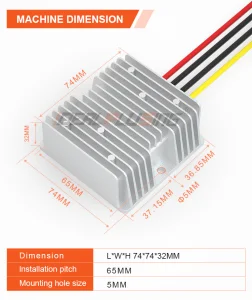
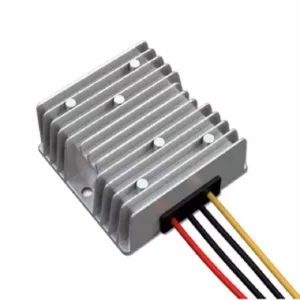
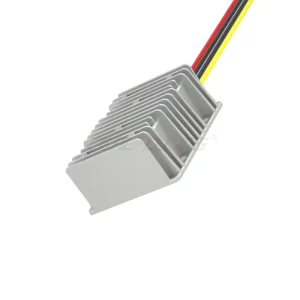
Optimized boost modules designed to stabilize local battery arrays and industrial equipment in high-demand industrial nodes.
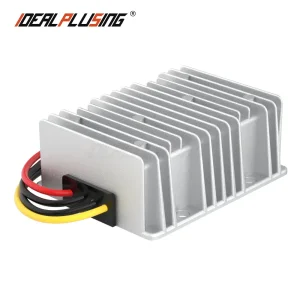
As the Port of Antwerp-Bruges transitions toward becoming a carbon-neutral logistical hub, the integration of heavy electrification, Automated Guided Vehicles (AGVs), and smart marine vessels has expanded. In these environments, raw voltage drops across long wiring harnesses or dynamic discharge curves in massive lithium battery systems present severe threats to system reliability.
Step-up (boost) DC-DC converters act as the critical voltage stabilization backbone. Whether transitioning 12V shipboard auxiliary systems to 24V or 48V sensor grids, or charging 56V EV storage cells from local 24V distribution nodes, precision voltage boosting ensures continuous operation without efficiency losses.
Our converters protect control modules from voltage sags during critical operations, maintaining high conversion efficiency in low ambient conditions.
Antwerp's maritime corridors demand resilience to salt-fog and humidity. Engineered using thermal silicone casting, our modules prevent moisture penetration.
Pioneering tomorrow's power density standards through advanced topologies, smart telemetry, and wide bandgap semiconductors.
We are incorporating Gallium Nitride (GaN) and Silicon Carbide (SiC) switches into our next-generation boost converters, reducing thermal footprint by 35% and elevating switching frequencies up to 500kHz.
For smart microgrids and clean energy installations across the docks, our single-inductor MPPT controllers adapt dynamically to capture maximum energy under partial shading conditions.
Our waterproof series features a vacuum-impregnated epoxy encapsulation that satisfies both IP67 protection standards and shock/vibration protocols for marine hulls.
"The challenge of scaling DC voltage from 12V/24V levels to higher rails is managing thermal dissipation and high-frequency noise. Our design methodology targets both, minimizing EMI and maximizing heat transfer through customized aluminum enclosures." — Chief Engineering Director, JDI Power
Engineered specifically for wet, high-salinity harbor environments and outdoor vehicle charging grids.
ShenZhen JDI Power Supply Co., Ltd. is a national high-tech enterprise focused on the research, development, and high-volume manufacture of professional, personalized power converters. Established in 2004 and situated in Shenzhen, our 6,000-square-meter production base operates under ISO9001:2008 and ISO14001 certification standards.
With an engineering team led by a veteran designer with 27 years of power topology expertise, we execute robust stress testing protocols, high/low temperature cycles, vibration testing, and electromagnetic compatibility (EMC) mapping. This guarantees our power supplies conform to global specifications like CE, GS, UL, and PSE.
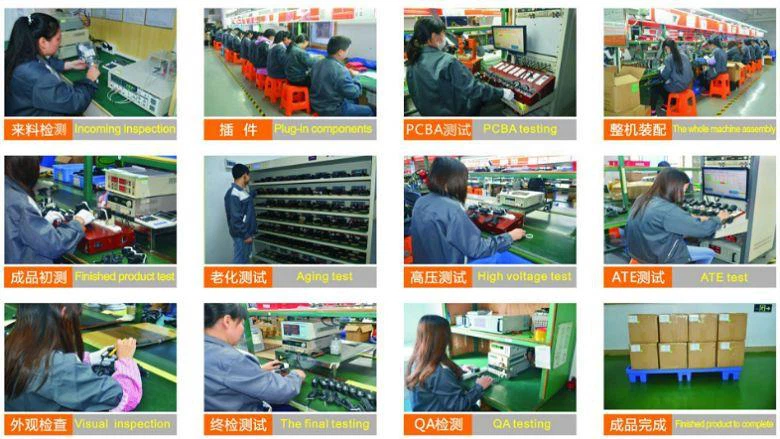
To ensure high operational reliability under field conditions, all JDI Power products undergo dynamic test protocols inside our designated testing laboratories:
Alternating hot and humid test cycles alongside accelerated thermal aging to isolate component vulnerabilities before shipping.
FMEA pinpoint evaluations, static electrical discharge, and transient response profiling to map step-up stability under load.
Tested to comply with EN 62368, EN 60601, and UL1310 standards, confirming low EMI emission profiles.
Bridging Shenzhen's manufacturing output with Belgium's compliance requirements and logistics infrastructure.
Every step-up converter exported to Antwerp aligns with RoHS and REACH regulations, eliminating supply disruptions at customs check-ins.
We leverage express ocean freight lines directly to the Port of Antwerp-Bruges, alongside continental rail networks, ensuring stable wholesale supply chains.
We provide localized engineering evaluation support. Our Shenzhen R&D team works closely with Antwerp clients to customize voltage thresholds and chassis form factors.
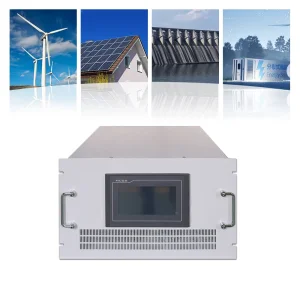
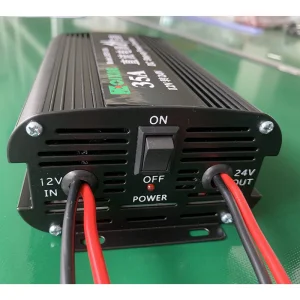
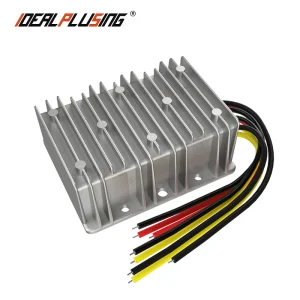
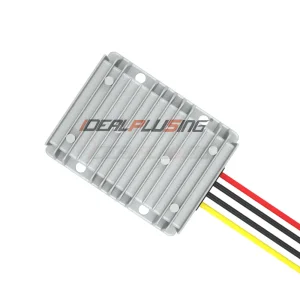
Full technical array of power boost systems suitable for rail transit, wind installations, and microgrid applications.
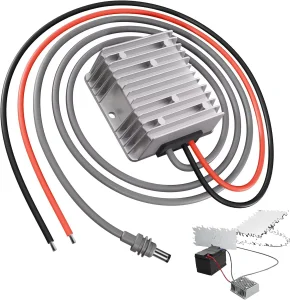
Answers to common design and integration challenges for high-power DC-DC boost modules.
A: AGVs operate on high-density battery packs where voltage drops during heavy acceleration. A step-up converter takes lower battery output and steps it up to feed auxiliary sensors and motors with a stabilized voltage rail. This prevents brownouts and ensures continuous operations without system resets.
A: Antwerp's shipping channels expose electronics to salt-spray, high humidity, and temperature transitions. IP67-rated converters are encapsulated in silicon or epoxy potting, protecting components from moisture, salt corrosion, and mechanical vibrations.
A: Our converters utilize synchronous rectification instead of standard diodes, minimizing switching and conduction losses. This results in less waste heat, allowing our high-power converters (such as our 960W configurations) to work efficiently in enclosed spaces.
A: For Belgium and the broader EU, converters must carry the CE mark. They should comply with safety standards like EN 62368-1 for information technology equipment, or EN 60601-1 for medical configurations, alongside RoHS and REACH environmental guidelines.
A: We incorporate multi-stage LC filters on both input and output terminals. Combined with metal-shielded enclosures and optimized PCB trace geometry, our modules satisfy EN 55032 Class B limits, protecting surrounding communication devices.
 JDI Power Supply